

Producing high-quality hardcover products requires accurate positioning, consistent material handling, and reliable pressing operations. In particular, corner quality and tight finishes directly affect the appearance and durability of finished covers. Manual operations can make it difficult to maintain the same results across large production batches. Therefore, an automatic hardcover case making machine helps manufacturers improve production consistency by automating key stages from board feeding to final pressing.
Why Are Flawless Corners Important in Hardcover Production?
Corners are among the most noticeable details of a hardcover book, photo album, or specialty packaging product. Poorly aligned materials, uneven folding, or insufficient pressing may create visible gaps, irregular edges, and loose finishes. These problems can affect both product appearance and perceived quality. For this reason, manufacturers need to maintain accurate positioning and consistent processing throughout hardcover production.
A hard cover rigid box machine supports the manufacturing process by coordinating different operations involved in cover making. When material feeding, positioning, and pressing work together, manufacturers can achieve more controlled production results. In addition, automated processing helps reduce variations caused by repeated manual adjustments.
How Does Automated Processing Improve Corner Accuracy?
Accurate corners depend on several connected production stages rather than a single operation. The board must be fed and positioned correctly before the cover materials are processed and pressed. If the material shifts during production, the resulting edges and corners may become uneven. Consequently, an integrated production system can help maintain more consistent positioning throughout the workflow.
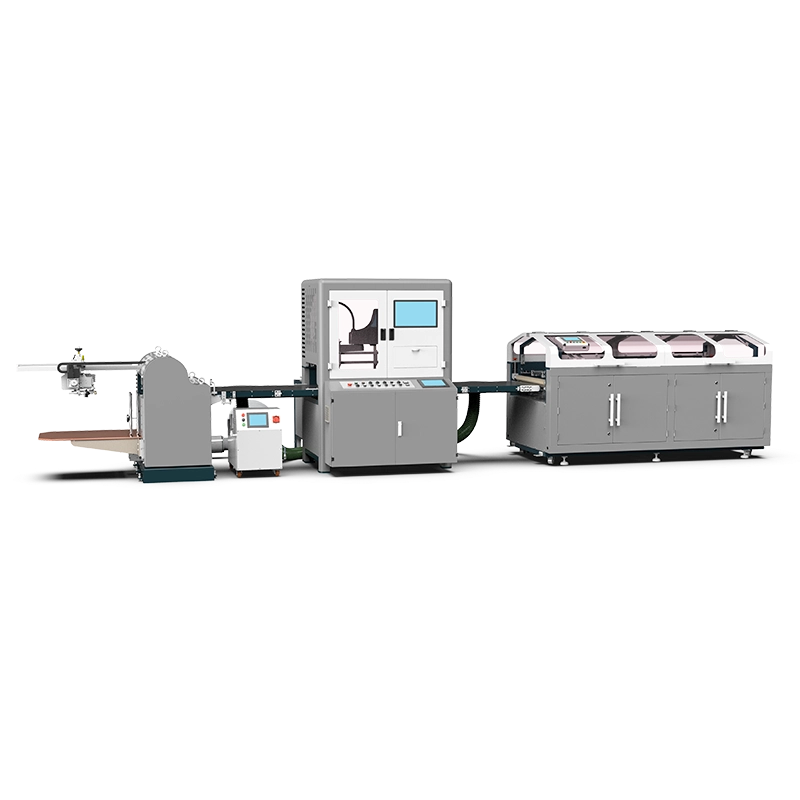
The Case Making Machine HM-FM850 / HM-600H + HM-PK850D / TN850 is designed to streamline hardcover production from board feeding to final pressing. Its fully computerized controls help calibrate each cover during processing, supporting sharp corners and tight finishes. By coordinating the production stages, this automatic hardcover case making machine helps manufacturers manage repetitive cover-making tasks with greater consistency.
What Features Support Tight and Consistent Finishes?
Computerized control is an important part of the system’s operation. It helps maintain consistent processing conditions and supports accurate cover calibration. Furthermore, an automated workflow can reduce the need for repeated manual adjustments, allowing manufacturers to organize production more efficiently.
The main production advantages include:
- Automated board feeding: Supports the initial material-feeding stage and helps establish an organized workflow.
- Computerized controls: Help calibrate covers during production for consistent processing.
- Integrated production stages: Streamline the process from board feeding to final pressing.
- Precise cover processing: Supports the production of sharp corners and tight finishes.
- Automated workflow: Helps improve production output and consistency across repeated operations.
Together, these functions make the system suitable for manufacturers that need repeatable hardcover production. However, the final result also depends on material quality, board specifications, cover construction, and appropriate machine settings.
How Does an Integrated Production Line Improve Efficiency?
An integrated production line connects multiple processing stages into a coordinated workflow. Instead of managing each operation as an isolated task, manufacturers can use a connected system to streamline material handling and cover production. As a result, production becomes more organized, and operators can manage repeated manufacturing tasks more consistently.
The following table summarizes the documented capabilities and their roles in hardcover production.
| Production feature | Main function | Manufacturing benefit |
|---|---|---|
| Board feeding | Feeds board material into the production process | Supports an organized workflow |
| Fully computerized controls | Calibrates covers during processing | Helps maintain processing consistency |
| Integrated workflow | Connects board feeding with final pressing | Streamlines hardcover production |
| Final pressing | Completes the cover-making process | Supports tight and consistent finishes |
| Automated operation | Coordinates repeated production tasks | Helps improve output and consistency |
For manufacturers planning a high-speed rigid box production line, it is important to evaluate how each machine fits into the overall workflow. Equipment compatibility, material specifications, production capacity, and operator requirements should all be considered before making an investment. In addition, buyers should confirm the actual operating speed and supported material dimensions with the equipment supplier, as these specifications are not included in the available product description.

What Should Buyers Consider When Selecting Hardcover Equipment?
When comparing a heave-duty case making machine, buyers should first identify their product types and production requirements. Hardcover books, photo albums, and specialty packaging may involve different material structures and finishing expectations. Therefore, manufacturers should confirm that the equipment supports their intended applications and required cover specifications.
Buyers should also review several practical factors before purchasing:
- Product compatibility: Confirm whether the system is suitable for the intended hardcover, album, or specialty packaging products.
- Production workflow: Understand how board feeding, cover calibration, and final pressing are coordinated.
- Material requirements: Verify the supported board and cover material specifications.
- Control and operation: Review the computerized control functions and operator requirements.
- Production capacity: Confirm the actual output and operating speed with the supplier.
For export-oriented manufacturers, an export-quality box wrapping machine may also be part of a broader packaging production setup. However, buyers should distinguish between hardcover case-making operations and downstream wrapping processes to ensure that each piece of equipment meets its intended production role.
Supporting Hardcover Manufacturing with Hongming
The HM-FM850 / HM-600H + HM-PK850D / TN850 system is designed to streamline hardcover production through computerized controls and an automated workflow from board feeding to final pressing. It supports accurate cover calibration, sharp corners, and tight finishes while helping manufacturers improve production output and consistency. Hongming provides machinery for businesses producing hardcover books, albums, and specialty packaging.
When choosing an automatic hardcover case making machine, manufacturers should consider the complete production process rather than focusing on a single finishing function. By evaluating material compatibility, control requirements, workflow integration, and production capacity, businesses can select equipment that better matches their manufacturing needs. A well-organized production system can help maintain consistent cover quality while supporting more efficient hardcover manufacturing.