

Hard cases are widely used for wine boxes, gift boxes, tea boxes, book covers, and other premium packaging applications. Because these products require clean edges and consistent shapes, the four-side folding process needs accurate positioning and stable mechanical movement.
A four side folding machine provides an automated solution for folding all four sides of a hard case in a coordinated process. By combining servo motor control with mechanical cam transmission, the machine can achieve synchronized folding while maintaining stable operation. As a result, manufacturers can improve production consistency and reduce the amount of manual adjustment required.
How Servo and Cam Drive Work Together
The servo motor provides controlled movement, while the mechanical cam transmission converts that movement into the required folding actions. This combination allows the machine to coordinate the four folding sides according to programmed parameters. Furthermore, the cam structure provides a stable mechanical transmission process. Compared with a more complicated drive system, a mechanical cam can offer a straightforward structure with fewer potential control points. Therefore, it can contribute to reliable operation and consistent folding performance.
At the same time, servo control allows operators to adjust operating parameters more precisely. This combination of electronic control and mechanical transmission creates a balanced solution for automated hard case production.
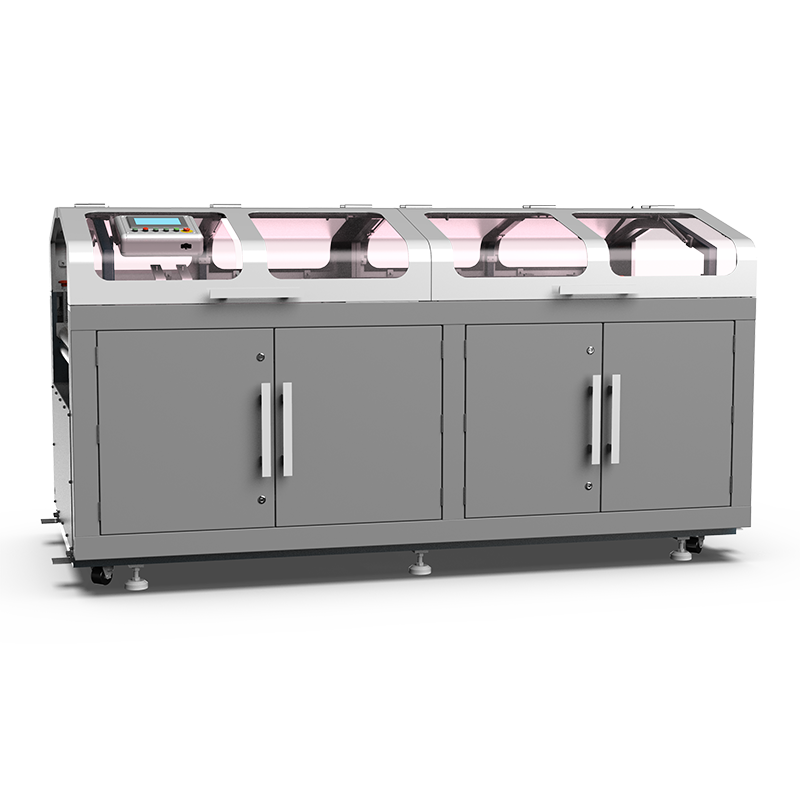
Key Features of the Automatic Folding System
The machine is designed for automatic four-side folding of hard cases and can operate independently or as part of a complete production line.
Key features include:
- Four-side simultaneous folding: Folds four sides of a hard case within one automated process.
- Servo motor control: Provides accurate movement and adjustable operating parameters.
- Mechanical cam transmission: Supports stable operation and a straightforward drive structure.
- PLC control: Coordinates machine functions through programmable logic control.
- Touchscreen interface: Allows operators to set and adjust production parameters conveniently.
- Automatic error stop: Stops operation when an abnormal condition is detected.
- Error display: Provides information to help operators identify production issues.
- Flexible production: Can work as an individual machine or integrate into an automatic production line.
- Easy adjustment: Simplifies setup when production requirements change.
Why Cam Transmission Supports Stable Operation
Mechanical transmission plays an important role in maintaining stable machine performance. The cam mechanism provides a predetermined movement path for the folding process. Consequently, the folding action can follow a consistent sequence during repeated production cycles.
In addition, the mechanical structure can reduce unnecessary complexity in the transmission system. This contributes to a lower failure rate and helps maintain dependable operation during continuous production. Therefore, the cam drive is not simply a transmission component. It is also an important part of the machine’s overall stability and production efficiency.
Servo Motor Improves Folding Control
While the cam provides mechanical movement, the servo motor adds precise electronic control to the system. Operators can adjust relevant parameters through the touchscreen interface according to the hard case specifications.
As a result, the machine can adapt to different production requirements more conveniently. Moreover, servo control can help coordinate movement between different folding actions, which is important when all four sides need to be processed in a synchronized sequence. The combination of servo control and cam transmission therefore provides both flexibility and mechanical stability.
Comparison with Manual Four-Side Folding
Manual folding requires workers to position and fold each side individually. Although this method can be suitable for small-scale production, it may require more labor and can lead to variations in finished case dimensions. Automated folding provides a more consistent process by controlling the movement mechanically and electronically.
| Feature | Automatic Four-Side Folding | Manual Folding |
|---|---|---|
| Folding Process | Automated | Manual |
| Four-Side Operation | Simultaneous | Usually sequential |
| Movement Control | Servo + cam | Operator dependent |
| Parameter Setting | Touchscreen | Manual adjustment |
| Production Consistency | High | May vary |
| Labor Requirement | Lower | Higher |
| Production Line Integration | Supported | Limited |
| Error Handling | Automatic stop and display | Manual detection |
Therefore, automated folding can provide significant advantages when manufacturers need repeatable production and reduced manual intervention.
PLC and Touchscreen Control
Modern packaging equipment requires not only mechanical accuracy but also convenient operation. The machine uses PLC automatic control to coordinate the different functions during the folding process. The touchscreen human-machine interface allows operators to set production parameters directly. Furthermore, the interface makes machine adjustment more convenient when changing product specifications.
Automatic error stopping and error display provide an additional layer of operational support. When an abnormal condition occurs, the machine can stop automatically and display the relevant information. Consequently, operators can respond more quickly and reduce the risk of continued operation under unsuitable conditions.
Efficient Folding for Different Hard Case Applications
The machine is specially designed for a range of grey board packaging applications. These include wine boxes, book covers, gift boxes, tea boxes, and other rigid packaging products.
Because different packaging products can have different dimensions and folding requirements, easy adjustment is an important advantage. Operators can configure the machine according to the production parameters and then run the folding process automatically. As a result, manufacturers can use one automated system across different hard case production applications.
Four-Side Folding Improves Production Efficiency
Folding four sides individually can increase production time and require additional labor. By processing the four sides within one coordinated operation, automated equipment can simplify the overall workflow. The four side folding machine is capable of folding all four sides of the hard case at the same time. Therefore, the process can reduce unnecessary handling and support faster production cycles.
Moreover, the machine can operate independently or connect with other equipment to form an automated production line. This flexibility allows manufacturers to select a production configuration according to their available space and output requirements.

Stable Operation for Continuous Production
For packaging manufacturers, stable operation is essential when equipment runs for extended production periods. Frequent interruptions can affect production schedules and increase maintenance requirements.
The combination of mechanical cam transmission and servo motor control helps create a stable operating structure. The cam provides consistent mechanical movement, while the servo system supports parameter-based control. In addition, the PLC system continuously coordinates machine functions. Consequently, the complete system can provide a more controlled production process.
Applications in Rigid Packaging
The equipment can be applied to various rigid packaging products made from grey board. Wine boxes can benefit from consistent four-side folding, while gift boxes can use the automated process to maintain uniform case structures. Similarly, tea boxes and book covers can be processed through the same basic folding mechanism. Therefore, the equipment provides flexibility for packaging manufacturers serving different product categories.
Why Choose Hongming?
Hongming provides automatic packaging machinery designed to improve folding efficiency, operational stability, and production consistency. The automatic four-side folding system combines servo motor control, mechanical cam transmission, PLC automation, and touchscreen operation.
Furthermore, the machine can operate independently or integrate with other equipment in an automatic production line. This makes it suitable for manufacturers looking to increase automation without creating an overly complicated operating process.
Building a More Efficient Folding Process
Automation can make a significant difference when hard case production requires consistent folding and repeatable results. Servo control provides adjustable movement, while cam transmission offers stable mechanical operation. At the same time, PLC control and touchscreen operation simplify parameter management. Automatic error stopping and display functions further support daily production.
Ultimately, the four side folding machine provides a practical combination of precision, stability, and efficiency for rigid packaging applications. By integrating mechanical transmission with intelligent control, manufacturers can achieve a more consistent folding process while reducing manual operations and supporting automated production lines.